WSU Home


FAQs

Advisement

Degrees and Programs

Faculty and Staff Contact Information

History and Mission

INTASC Portfolio Information


Ogden, Utah
home | index | search | contact me

History and Mission

January 1889 was the first time students entered “Weber Stake Academy” with the intention of pursuing “normal school” or teacher-preparation studies. Since that time, the preparation of teachers has been an important part of Weber State University’s institutional mission. The modern Department of Teacher Education traces its origins to the 1897-1898 academic year when the “Normal” Department became authorized to educate and certify students to teach in Utah high schools.  

During the first part of the 20th Century, demand for teachers greatly increased and so did the number of faculty and course offerings. Beginning in 1922, the Utah State Board of Education stipulated that Weber College instructors involved with teacher education needed to hold at least masters degrees. On March 19, 1959, Utah Governor George Clyde signed legislation that expanded Weber State into a four-year degree institution.  

NCATE provisional accreditation was first earned by the institution in 1967. As part of provisional accreditation, Weber State administrators agreed that a new building facility and greater faculty resources would be provided. Additionally, those involved in teacher education carefully redesigned the curriculum, field experience, and philosophy guiding certification programs under a large grant from the Carnegie Corporation of New York. What emerged was an individual program called “Weber Individualized Learning Kits,” or simply, WILKITs. In 1971, the Weber WILKIT program was honored by the American Association of Colleges for Teacher Education with its Distinguished Achievement Award, the highest national award for those involved with teacher education. 

WILKITs served faculty and students well into the early 1990s. Beginning in 1993, the Department of Teacher Education re-crafted its mission and philosophy into what would become the TREC Conceptual Framework, Teachers: Reflecting, Engaging, and Collaborating for growth.  

The TREC Conceptual Framework continues to inform curriculum, decision-making, and philosophy of teacher education programs. Current national trends have required TREC to incorporate candidate content-knowledge, teaching skills, and professional dispositions. Based on the inclusion of these, the Department of Teacher Education’s guiding philosophy for the beginning of the 21st Century is: Students, Teachers, and Communities Working Together.


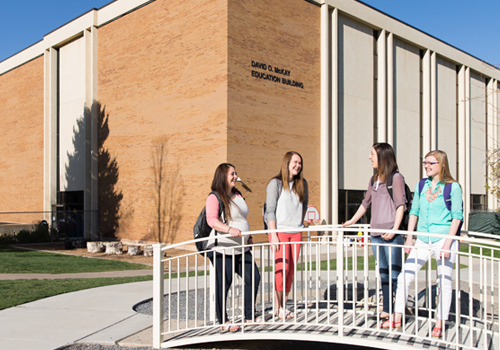
Weber State University, David O. Mackay Education Building,
Ogden, Utah 84408-1304
(DEPARTMENT OFFICE) 801-626-7171, (FAX) 801-626-7427